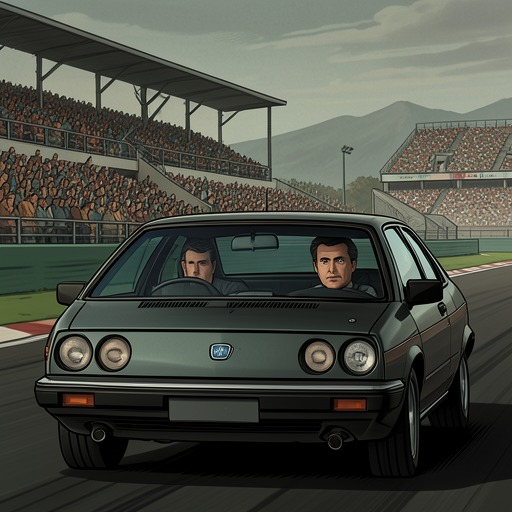
The car goes where the eyes go
The Art of Racing in the RainThe car goes where the eyes go is both a driving instruction and a recurring principle about attention in The Art of Racing in the Rain. On the track, it directs a driver’s gaze beyond the turn currently being negotiated; across the story, it becomes a way to consider how expectation and focus shape a person’s experience of what comes next. The rule is not presented as a guarantee that looking toward an outcome will control it. Instead, its force lies in the uneasy connection between what people are taught to anticipate, what they continue to see, and the course they then struggle to escape.
Racing Principle
Denny gives the rule a concrete form when he takes Enzo around the track. He tells Enzo to use “Big eyes, far eyes,” directing him toward reference points identified during their walk around the course. The markers pass too quickly for Enzo to understand at first that Denny is no longer watching them individually. Denny has already absorbed the track’s layout, carrying its turns in his mind like a navigation system.
His gaze is not fixed on the apex of the turn the car is entering. As the car slows, he is already looking toward the next turn, and then the one beyond it. The present corner remains real, but it does not monopolize his attention: Denny is settled into the turn while preparing for what follows. Enzo recognizes in this pattern a combination of concentration and ease. Denny adjusts, reassesses, and corrects with each breath, yet those operations have become so practiced that they happen subconsciously.
That forward orientation also explains how Denny can plan a pass several laps before making it. The principle is therefore not simply to look farther down the road; it describes a method of joining immediate control to long-range strategy. A driver must respond accurately to the current turn while keeping the coming sequence in view. In Enzo’s account, this lap makes Denny’s thinking visible to him: attention reaches ahead, but the driver’s skill consists in acting correctly where the car is now.
Attention and Diagnosis
The maxim acquires a more painful significance through Eve. After an exchange with her, Enzo reflects that doctors could help many people but, in Eve’s case, had told her what could not be done. He understands her situation as one in which the diagnosis became the dominant view: those around her accepted it, reinforced it, and repeated it. His conclusion, “The visible becomes inevitable,” links the language of sight to the frightening power of a prognosis once it has become the only future everyone can name.
The connection is Enzo’s interpretation, not a claim that Eve’s illness was caused by her outlook. His reflection concerns the way a diagnosis can organize attention and expectation, especially when other people continually return the patient to the same account of what lies ahead. The repeated maxim gives shape to that trap: what is kept in view may begin to feel unavoidable. Yet Eve’s words remain with Enzo as a counterweight. Thinking of her, he resolves to face even the prospect of a firing squad without a blindfold and recalls her insistence that an ending is not necessarily the end.
Enzo later applies the same language to his own diagnosis of hip dysplasia. Hearing the veterinarian repeat it, he imagines the pain and decline that the diagnosis seems to mark out for him. He compares his fear with Eve’s response to her terminal diagnosis, remembering how quickly she embraced death once people around her agreed that it was coming. For Enzo, the analogy exposes the risk of treating a predicted future as already settled. He cannot dismiss the suffering he expects, but he tries to look away from the route the diagnosis appears to have laid before him.
The Rule Beyond the Track
The principle also recurs in Enzo’s account of fortune. During a visit with Mike, Denny sits in the kitchen with tea and a manila folder while Mike paces nervously. Their circumstances contrast with the small house, which reflects a different level of income: Tony, Denny has said, happened to stand in the right place at the right time and would never need to worry about money again. Enzo connects that account of luck with the language of manifesting and sight. The episode does not establish that Tony deliberately directed events or that attention alone produced his wealth. Rather, the maxim gives Enzo a way to place sharply unequal outcomes within his running meditation on where people find themselves and what they understand as attainable.
That recurrence broadens the rule without erasing its practical meaning. On the circuit, looking ahead is a trained action supported by knowledge of the course; in reflections on illness and fortune, the phrase becomes more ambiguous. Attention can support preparation, but it can also be narrowed by fear, authoritative predictions, or the repeated expectations of others. The contrast between Denny’s active reading of the track and Enzo’s dread of his medical signposts keeps the maxim from becoming a simple promise of self-determination.
Closing Affirmation
At the novel’s close, a boy tells a champion in Italian that the car goes where the eyes go. The champion laughs, looks to the sky, and confirms the principle in English, calling it true. The exchange turns the instruction into a saying that can pass between speakers and languages, and it returns the story to the image that has connected racing with attention throughout.
The ending affirms the maxim without reducing it to a formula for controlling life. Its racing meaning remains exact: a driver must look toward the course ahead. Its wider meaning is more unsettled, shaped by the different futures Denny, Eve, and Enzo confront. The rule’s lasting significance rests in that tension. Looking ahead can make skilled action possible, but the story also asks what happens when the future in view has been narrowed to a diagnosis or an expected loss. The final exchange carries the rule forward as hard-earned guidance, not as proof that every outcome can be chosen.